News
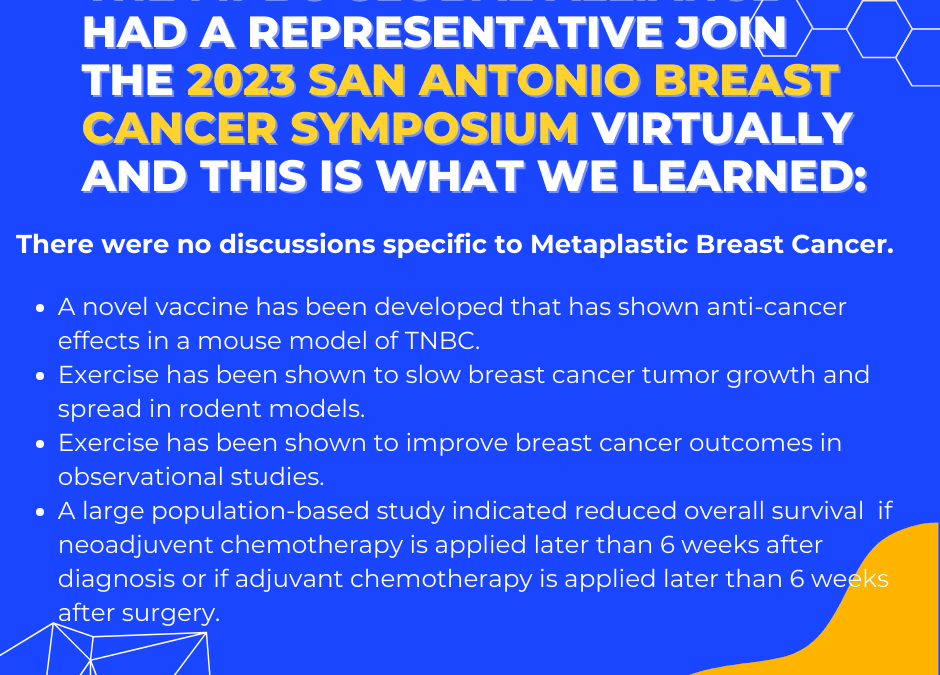
The MPBC Global Alliance Had a Representative Join the 2023 San Antonio Breast Cancer Symposium Virtually, and This is What We Learned
There were no discussions specific to Metaplastic Breast Cancer.
- A novel vaccine has been developed that has shown anti-cancer effects in a mouse model of TNBC.
- Exercise has been shown to slow breast cancer tumor growth and spread in rodent models.
- Exercise has been shown to improve breast cancer outcomes in observational studies.
- A large population-based study indicated reduced overall survival if neoadjuvant chemotherapy is applied later than 6 weeks after diagnosis or if adjuvant chemotherapy is applied later than 6 weeks after surgery.
Credit to SABCS 2023 in “Recent advances in triple–negative breast cancer”
Below is the latest information we gained in regards to TNBC:
- Advances in early-stage TNBC:
- Adjuvant capecitabine improves disease-free & overall survival
- Pembrolizumab, in addition to neoadjuvant chemotherapy, improves event-free survival
- Adjuvantolaparibimproves disease-free & overall survival in gBRCAl/2 mutation-associated high-risk breast cancer
- Carboplatinaddition to neoadjuvant anthracyclineandtaxanebasedchemotherapy improves disease-free& overall survival
- Advances in advanced stage TNBC:
- Olaparib & talazoparib improve progression-free survival in gBRCAl/ mutation-associated breast cancer
- Pembrolizumab improves progression-free& overall survival in PDLl+ advanced TNBC
- Sacituzumab govitecan (Trodelvy) improves progression-free & overall survival in pre-treated advanced TNBC
- Trastuzumab deruxtecan improves progression-free & overall survival in re-treated advanced HER2 low breast cancer including TNBC”
- Nearly one-half of breast cancer patients surveyed reported significant financial burden due to breast cancer
- Regional nodal irradiation after neoadjuvant chemotherapy and breast cancer surgery does not improve overall survival, according to a study
MpBC Global Alliance Inc. Key Takeaways:
Continue to focus on gaining more research and attention specific to Metaplastic Breast Cancer without lumping us into TNBC.
Future Goals:
Support a conference/symposium specific to MpBC.
Sources:
Telli, M. (n.d.). San Antonio Breast Cancer Symposium
2023. In recent advances in triple-negative breast cancer. San Antonio.
Leon-Letelier, R. (n.d.). San Antonio Breast Cancer Symposium 2023. In a novel citrullinated-ENOl-peptide based vaccine for triple-negative breast cancer prevention.
Chino, F. (n.d.). San Antonio Breast Cancer Symposium
2023. In Patient-Reported Benefits of Resources Designed to Assist With the Financial Toxicity of Breast Cancer.
Courneya, K. (n.d.). San Antonio Breast Cancer Symposium
2023. In Im act of Exercise on Breast Cancer Outcomes

diagnosis, Information, News
It’s ok to get a second opinion (and a third and a fourth)
As a Metaplastic Breast Cancer (MpBC) patient, your diagnosis and path forward may not always be clear. It’s a disease that still lacks awareness and education – even among oncologists. If you’re not feeling confident with the information that you’re receiving from your care team or simply want another expert to confirm you’re on the best path, you should have complete confidence in getting a second opinion.
An article by Yale Medicine states, “Patients should seek another opinion if they feel uncomfortable with their initial team, if they have a rare cancer that another doctor may have more expertise with, or if they are confused about their diagnosis or treatment options.”
“When my mom’s oncologist started rolling her eyes when I brought up Metaplastic Breast Cancer, I knew it was time for a second opinion,” said Jessica Brooke, daughter, and advocate of a MpBC patient. “I took my mom to five leading cancer hospitals. The doctors I trusted embraced collaboration, welcomed questions, and treated my mom like a whole person instead of a diagnosis.”
Below are second-opinion tips from the Patient Advocate Foundation and the Mayo Clinic that resonate with us:
Be Clear What You’re Looking For From a Second Opinion
Do you need confirmation that your current treatment recommendation is correct for you? Or are you looking for other options? Are you interested in clinical trials? As you work with any new doctor, explain why you’re seeking a second opinion, and communicate your primary needs for the visit.
Feel Empowered and Take Control
By seeking a second opinion, you will naturally become more informed about all of your available treatment options and even have a better sense of the possible side effects of each. Many patients say that learning more about their condition and treatment helps them feel more in control of their health and ensures they make the best decisions.
Find a Doctor You Really Like
Most doctors understand that patients have the right to a second opinion and often encourage it. You are under no obligation to be treated by the first doctors you see. When meeting with a new doctor, pay attention to the nurses, office staff, and environment to ensure you choose the best team for your treatment. You can find a list of doctors who work with Metaplastic Breast Cancer patients here.
Discover Alternate Treatment Options
Not all hospitals and doctors have access to the same treatment options. A second opinion could lead you to a more advanced treatment or one tailored to your needs.
Have No Fear
If a doctor is insulted by your choice to get another opinion or pressures you in any way, they may not be the best choice. Adding emotional stress between doctors and patients has been shown to keep patients from healing as fast as possible.
And here are a few pieces of second-opinion advice from our MpBC Community:
- “Absolutely, get a second opinion. My first doctor told me I had six months to live. That was in 2004. I got a second opinion, which truly saved my life,” Ann M.
- “Ask if your hospital has multidisciplinary tumor boards and confirm that your doctor participates. These expert groups review a patient’s records and discuss a diagnosis and treatment plan. Ask that your case be presented and request that your doctor brief you on the discussion the tumor board had about your case,” Jenna P.
- “Medicine is indeed a “practice,” and I wanted as many professional perspectives as possible to make informed decisions. I also felt like expanding my care team could only benefit me and provide exposure to more resources and opportunities,” Carolyn J.
- “I got three opinions and wound up feeling the most confident about the third one,” Bridget S.
- “I got a second opinion but ended up staying with my first doctor. The second opinion made me realize how much I trusted my first doctor,” Nicole P.
Articles cited in blog:
Should I get a second opinion? from Patient Advocate Foundation
Advice on Second Opinions from the Mayo Clinic

diagnosis, News

The Path to Diagnosis
You have breast cancer—four terrifying and instantly transformative words. In its most clinical form, the diagnosis can give a masquerading health culprit a name and illuminate a path forward for patient care. A diagnosis may even bring a sense of peace, “At least I know what I have.” For Metaplastic Breast Cancer (MpBC) patients, the journey to the correct diagnosis harbors extra challenges.
The experiences below are from our MpBC Global Alliance Community. You’ll see each is unique. If you are navigating your own MpBC diagnosis, you are not alone. Read the below and join our community on Facebook.
Carolyn R. | Triple Negative Metaplastic Carcinoma
Initial Symptoms: Small, painless lump approximately 1 inch in size
Initial Diagnosis: Invasive Ductal Carcinoma
Time from Initial Diagnosis to Metaplastic Diagnosis: Two years and four months. My initial diagnosis was corrected when I was considering entering a test trial to prevent recurrence of breast cancer. A new pathologist reviewed my original pathology slides from the hospital that did my surgery and gave me the MpBC diagnosis.
Notes of Interest:
- I received my diagnosis less than year since my most recent mammogram.
Advice to Others: All of your treatments will rely on the pathology report. I wish I had known the importance of having the pathology performed by a pathologist that specializes in breast cancer. Most community hospitals only have general pathologists, and not breast cancer specific specialists. If your pathology was performed by a general pathologist, get a second pathology opinion from a large cancer center or teaching hospital that has specialists. Once you have a MpBC diagnosis, get a treatment plan from a doctor specializing in MpBC.
Elizabeth S. | Triple Negative Metaplastic Carcinoma
Initial Symptoms: Small, marble-size lump in breast
Initial Diagnosis: Invasive Ductal Carcinoma
Time from Initial Diagnosis to Metaplastic Diagnosis: Six months
Notes of Interest:
- The lump grew fast. Within the two weeks between discovery and the initial breast MRI, the mass grew to 5cm.
- The tumors were inconsistent in their response to chemotherapy. There was an initial response to AC, but the tumor grew again while on Taxol.
- Doctors dismissed concern about tumor re-growth and said it was probably scar tissue.
Advice to Others: Keep pushing. If doctors decline a scan or test, demand documentation of their denial and medical rationale. Get a second and third opinion. Talk to others with your diagnosis.
Kathleen M. | Triple Negative Metaplastic Carcinoma with Spindle Cell and Squamous Cell Differentiation
Initial Symptoms: Small lump
Initial Diagnosis: Triple Negative Metaplastic Carcinoma with Spindle Cell and Squamous Cell Differentiation
Time from Initial Diagnosis to Metaplastic Diagnosis: Same time
Advice to Others: Be careful what you read. Everyone is different. Try not to stress; it makes it all worse.
Laura H. | Metaplastic Carcinosarcoma
Initial Symptoms: Painful breast lump
Initial Diagnosis: Sarcoma
Time from Initial Diagnosis to Metaplastic Diagnosis: One month
Advice to Others: Scan often – even during treatments. Research and become your own best advocate.
Sallie P. | Triple Negative Metaplastic Carcinoma with Squamous Cell Differentiation
Initial Symptoms: General feeling of being unwell with fatigue and generalized pain that doctors designated as fibromyalgia. All bloodwork and tests done to explore symptoms were normal. The symptoms lasted approximately five months before two lumps presented – one in the left breast and one in the left armpit.
Initial Diagnosis: Two independent primary cancers – invasive ductal carcinoma in the breast and squamous cell carcinoma in the armpit.
Time from Initial Diagnosis to Metaplastic Diagnosis: Nine months. The diagnosis kept changing from two independent primary cancers to one primary cancer.
Notes of Interest:
- No known genetic indicators or risk factors for breast cancer, and Sallie was up to date on preventative screenings.
- The lumps grew fast and seemingly appeared overnight.
- The tumors were inconsistent in their response to chemotherapy and immunotherapy, with one growing smaller and the other one initially shrinking but then continued growing.
- Doctors initially dismissed feedback that tumors were growing and said that tumors could behave “funny” and get inflamed while undergoing chemotherapy.
Advice to Others: It took going to four leading cancer hospitals before receiving a clear diagnosis and finding a doctor who regularly treats MpBC patients. If you aren’t comfortable with the information you’re getting related to your diagnosis, find another doctor. This disease demands elevated care and out-of-the-box thinking – don’t settle.
Vicky P. | Triple Negative Metaplastic Breast Cancer with Spindle Cell Differentiation
Initial Symptoms: None
Initial Diagnosis: Triple Negative Metaplastic Breast Cancer
Time from Initial Diagnosis to Metaplastic Diagnosis: Just over three weeks.
Notes of Interest:
- No family history of cancer.
- The tumor was found early by a routine mammogram.
Advice to Others: Be a squeaky wheel. If you’re in pain, ask for better painkillers. If you’re super nauseous, ask for better nausea meds. There is zero reason to suffer any more than you have to during treatment.


 Are you in a clinical trial or considering joining one? To help defray the costs of travel and lodging, we are excited to announce a new partnership between the Metaplastic Breast Cancer Global Alliance and the Lazarex Cancer Foundation. This partnership will provide reimbursement for lodging and travel expenses to patients participating in an FDA-approved clinical trial. We’re very excited about this partnership and look forward to seeing the positive impact it has on metaplastic breast cancer patients around the world! For more information, please email